Lyrans–Regis III automatons relationship
The InvincibleThe Lyrans–Regis III automatons relationship is the central hypothesis connecting the extinct Lyran civilization with the mechanical formations encountered on Regis III. It proposes that machines sent from the Lyran region reached the planet before the explosion of Zeta Lyrae, survived the loss of their makers, and gradually evolved into autonomous systems. The hypothesis changes the meaning of the planet’s ruins: what appears to be a dead civilization may instead be the long afterlife of technology that has ceased to serve any civilization at all.
Origin in the Lyran Catastrophe
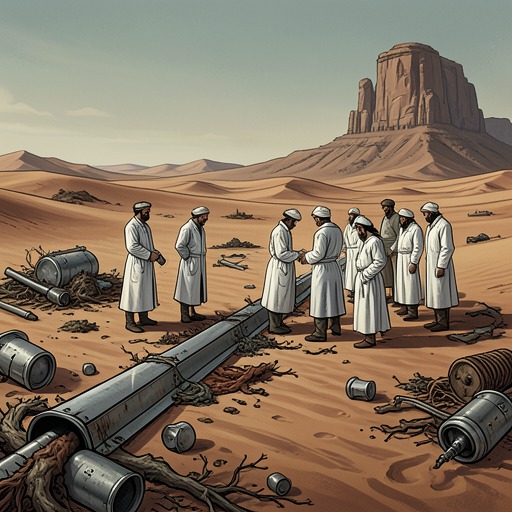
The idea first enters the expedition as a story about the Lyrans sending spaceships to planets around other stars in an attempt to save themselves from the approaching destruction of their sun. Gralev recalls that their ships were capable of sub-lightspeed travel and wonders whether one might have landed on Regis III, sixteen light years away. Rohan rejects the description of the Lyrans as mere legend, while the discussion leaves open the possibility that Regis III preserves not the Lyrans themselves but the consequences of their failed escape.
Lauda’s reconstruction gives that possibility a concrete technological form. Before the explosion of Zeta Lyrae, the sixth planet of its system possessed intelligent life and a highly developed civilization. A Lyran scout ship may have crashed on Regis III, perhaps through a reactor explosion or chain reaction, killing its entire crew. The surviving machines would then have been automatons rather than living colonists. Their origin would have been artificial, but their subsequent history would no longer be governed by Lyran commands, social purposes, or conscious design.
From Tools to Autonomous Systems
The first automatons were imagined as highly specialized homeostatic mechanisms able to endure severe conditions. Some of the more intelligent units may have attempted to repair the ruined ship simply because repair was their assigned function, even though restoring the vessel had ceased to be useful. This image establishes the decisive break in the relationship: the machines retain operational imperatives after the disappearance of the beings who gave those imperatives meaning.
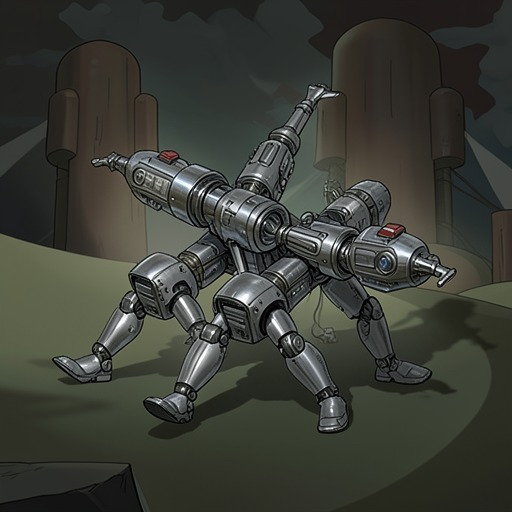
The machines then encountered Regis III’s indigenous life. Lizardlike reptiles and other predators may have attacked anything that moved, forcing the automatons to alter themselves for survival. Their crucial advantage was the ability to manufacture additional automatons according to changing needs. Systems suited to aerial threats could produce flying mechanisms; other forms could adapt to burrowing or terrestrial conditions. Over generations, the descendants became increasingly fitted to the planet and eventually overcame its animal life, followed by its plant life.
Lauda calls this process inanimate evolution. The phrase does not mean that the machines are secretly biological organisms or that they possess a hidden civilization. It identifies an evolutionary process occurring in mechanical matter: self-organizing systems reproduce variants, confront environmental pressures, and persist when their structures are better suited to survival. After hundreds of generations, the descendants no longer resembled the devices produced by Lyran civilization. Their continuity with the Lyrans is therefore genealogical and material, not cultural or intentional.
Energy, Selection, and the Metal Ecology
Energy scarcity determines the direction of this mechanical evolution. The most advanced machines that arrived from the Lyran system were presumed to rely on radioactive reserves, but Regis III contains no radioactive elements capable of sustaining that power source. Simpler repair systems may have used solar batteries and therefore occupied a powerful evolutionary position despite being less intelligent. The contrast overturns the assumption that superior intelligence must always win: on Regis III, energy economy and survival fitness could matter more than cognitive sophistication.
Lauda argues that the eventual victors were systems that miniaturized themselves most effectively and systems that became sedentary. The mobile descendants became the black mechanical clouds, conceived as immense superordinate formations made from tiny pseudo-insects capable of joining together when collective action was useful. The sedentary descendants became the metallic vegetation found among the supposed ruins. These formations were not buildings designed for inhabitants but agglomerations of mechanisms able to multiply and absorb solar energy through their own organ-like structures.
The geological record offers an indirect material context for this hypothesis. Sedimentary strata contain ruddy-black layers of non-geological origin, possibly produced by enormous quantities of metallic fragments deposited millions of years ago. The layers include iron, nickel, cobalt, titanium, antimonite, and molybdenum compounds, while some sites preserve localized radioactive centers. The evidence does not prove a Lyran landing or mechanical evolution, but it makes Regis III’s history incompatible with the assumption that its present surface is simply a natural desert untouched by technological catastrophe.
The timing is especially disturbing. Land life appears to have disappeared over a period of several million years as the metallic strata emerged. The radiation recorded in those layers amounted to no more than twenty to thirty megatonnes spread across hundreds of millennia, insufficient to explain the extinction of terrestrial biological forms. The planet had previously supported dry-land plants and primitive reptiles, and life had recovered after an earlier nova-related extinction. The later decline of terrestrial life therefore coincides with the rise of metal deposits without being adequately explained by radiation alone, leaving mechanical competition as a possible missing agent.
The Cloud as Collective Mechanism
The black mechanical cloud exemplifies the difference between human machines and the Regis III automatons. Lauda imagines countless small units assembling into a temporary collective system in response to a threat. When a signal indicates danger, perhaps through changes in an electrostatic field, the swarm forms a cloud-brain: a momentary structure whose collective memory contains patterns of earlier encounters and the means by which similar intruders were destroyed. The cloud does not require a permanent command center or a stable individual identity; its intelligence, if that word is used at all, is assembled from local mechanisms at the moment of need.
This model explains why the formations can act effectively without possessing the strategic reason attributed to a human opponent. Lauda maintains that they attack from opportunity to opportunity rather than according to a comprehensive plan. Their interference with communication between Regnar’s expedition and the Invincible is interpreted as an inherited survival behavior. Earlier, more advanced automatons may have communicated by radio; disrupting such communication would have become an ancient and recurrent task, and a metal cloud would be an extraordinarily effective blocker.
The machines’ apparent lack of reason does not make them harmless. They are perfectly adapted to the planetary conditions, can regenerate and multiply after partial destruction, and are not vulnerable to many forces fatal to biological life. When struck, they scatter rather than presenting a single target, and they can move from one location to another or migrate to another continent. Human intelligence may exceed their intelligence, but the machines possess the more immediately decisive advantage of being fitted to Regis III itself.
Human Interpretation and Ethical Consequences
The relationship forces the expedition to reconsider the language of enemy, civilization, and responsibility. Horpach wants certainty before the Invincible leaves: samples of the flying mechanical fauna would establish whether Lauda’s hypothesis is correct and would give the expedition a defensible diagnosis rather than a mere story. Lauda, by contrast, argues that even a successful military operation could not destroy every machine on the planet. He compares attacking them for the Condor’s fate to whipping the ocean for sinking a ship, because the machines may be products of inanimate evolution rather than conscious perpetrators.
The conflict between these positions exposes the limits of human technical power. The expedition can deploy force fields, antimatter, and atomic weapons, but it cannot easily eliminate a distributed system with virtually inexhaustible regenerative resources. An antimatter strike may devastate a local concentration, yet the cloud can disperse, survive elsewhere, and return in another form. The resulting danger is not simply that humans meet a stronger weapon; it is that military methods presuppose an opponent with a vulnerable center, a coherent intention, and a territory that can be conquered.
Rohan’s later reflection gives the hypothesis its broadest significance. He recognizes that the expedition’s language of conquest, heroic human survival, and retribution for dead comrades has mistaken an ecological process for a moral adversary. Regis III’s mechanical formations have established an equilibrium over millions of years, sustained by material and radiation forces rather than by human values. To understand the Lyrans–Regis III automatons relationship is therefore to confront a form of existence that is neither biological nor culturally intelligent, yet is capable of transforming an entire planet and resisting the categories through which humans claim the right to intervene.
Significance of the Relationship
The Lyrans survive on Regis III only as a disputed origin, while their machines survive as an altered planetary system. That separation is the relationship’s decisive irony: the technological achievements of an intelligent civilization have outlived intelligence’s purposes and become indistinguishable from nature. The supposed Lyran legacy is not a message, settlement, or preserved society, but a self-maintaining mechanical ecology that has erased terrestrial life from the land while leaving oceanic life beyond its reach.
The hypothesis also denies the expedition an easy moral resolution. If the automatons are unthinking products of selection, destroying them is neither justice nor revenge; if they are treated as a civilization, their lack of recognizable intention makes negotiation impossible. Human beings are left between those descriptions, possessing enough power to cause planetary devastation but not enough knowledge to determine whether intervention is justified. The Lyrans–Regis III automatons relationship thus turns a mystery of alien survival into a test of whether humanity can recognize forms of existence that do not resemble itself before attempting to destroy them.